Dark-eyed Junco
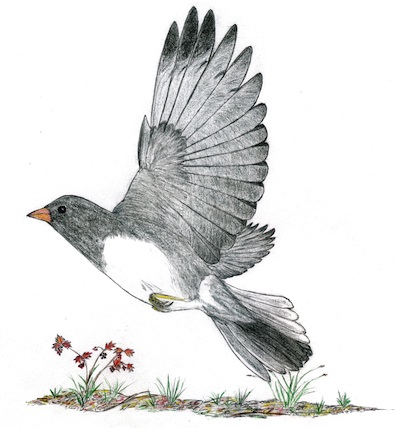
Junco hyemalis
I never observed this little gray and white sparrow in the treeless parts of the Y-K Delta where I taught, so that might explain why I didn’t find a Yup’ik name for it. But upriver on both the Yukon and Kuskokwim Rivers where there are tall trees you will see it, that is, if you look hard enough, for this bird is so nondescript you may not notice it.
The scientific name of the Dark-eyed junco is Junco hyemalis, meaning “winter juncus reed bird,” which I think says something of its ability to stick around during the winter. I know from personal experience that there are always a few of these juncos that frequent feeders in Fairbanks all winter long. In fact, we recently had one in our own back yard for a few cold snowy weeks in October. We saw it even in the darkness of the early morning and evening. Unlike chickadees and redpolls, they don’t have the same efficient strategies of surviving the cold winter temperatures of the Alaskan Interior and must eat almost continuously. Which made us wonder if they ate all night long?
Most juncos are migratory birds, though, and in early spring return to Alaska for two reasons, to feed and breed. They are, in fact, one of our earliest sparrows to arrive back in Alaska in spring, often before the snow disappears. And when they do return, they arrive in flocks on their old nesting grounds, probably the same ones their ancestors used for countless generations.
On arrival, the males immediately proclaim their territories by singing from the tops of the tallest trees. You’ll recognize the male’s territorial song by its jingling trill, which sort of reminds me of the call notes of the first cell phones.
During courtship, both male and female hop around on the ground with wings drooped and tail fanned wide, showing off their white outer tail feathers. As the male perches on a low limb, he performs similar behavior while singing softly to the female.
After the female makes her choice of a mate, she selects a well-hidden nest site on the ground and builds a cup-shaped nest of grass, leaves and other plant material, then lines it with fine grass, hair or feathers. Meanwhile, mating takes place and lickety split 3-5 splotchy pale bluish-white eggs are laid and incubated solely by the mother bird for 11-13 days. Although both parents feed the nestlings, mom broods them. Meanwhile they are growing like gangbusters, and in less than two weeks are out of the nest and into the air.
An interesting tidbit about baby juncos is that their feet grow more quickly than those of tree nesters, thus allowing them to run from their nest if they are threatened before they can fly.
Once the young have fledged, the mother bird does not usually remain with her young. That’s dad’s job as mom heads back to the nest to lay another smaller clutch of eggs to better ensure the survival of the species. Like he did when the young were still in the nest, the father bird makes sure his progeny fatten up on insects. As autumn draws near, however, and there are fewer insects to eat, the juvenile juncos eat more and more seeds and even a few berries. By this stage they have learned most of the tricks of the trade and are fat enough to begin their migration south to warmer climes. That is, except for a few hardy individuals who hang around all winter at someone’s feeder.
Our Alaskan Dark-eyed juncos have many cousins in other parts of North America, some of them actually quite colorful compared to our slate-colored variety. To best appreciate them, go to your bird guide. My favorite of the six cousins is the Oregon junco. With his rufous jacket and black hood, the male almost looks like a Spotted towhee. Our slate-colored males up here also have a black hood. I’ve had a family of these juncos nesting in my yard for many summers now.
If the number of pet names a bird has is any indication of how endeared they are to humans, juncos must be well-loved. Here are just a few: Black chipping bird; black snowbird; blue snowbird; Carolina junco; Cassiar junco; common snowbird; eastern junco; gray snowbird; slate-colored snowbird; snowbird; and white-bill.
What a bird!